Mechanism of action

Unlike other iron formulations that contain an iron core surrounded by a layer of carbohydrate, Monoferric utilizes a dynamic matrix of alternating iron and carbohydrate layers1,2


Components

Delivery

Release

Components


Delivery


Release

  • Monoferric provides a slow and controlled release of bioavailable iron3
  • Tightly bound bioavailable iron slowly leaves the matrix to then bind to transferrin for incorporation into hemoglobin. Red blood cell production follows4,5
  • Excessive parenteral iron therapy may result in iron overload. Monitor hemoglobic response and iron paramaters during treatment. Do not administer Monoferric to patients with iron overload

This description reflects structural chemistry only and does not imply differences in clinical efficacy, safety, or tolerability.

Innovative matrix controls bioavailable iron release

HAVE A QUESTION ABOUT HOW MONOFERRIC WORKS?

Sign up to contact a representative and receive information about Monoferric.
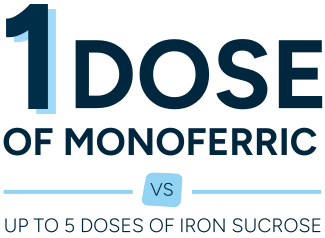
The safety and efficacy of Monoferric for treatment of IDA were evaluated in two randomized, open-label, noninferiority, actively controlled clinical trials performed in a total of 3050 patients with IDA of different etiologies.2,6

Complete IV iron replacement in as little as 20 minutes4,a

See dosing & administration

a Intravenous infusion over at least 20 minutes. Repeat dose if IDA reoccurs.

Monoferric patient profiles

Do you see any of these types of patients in your practice? See why Monoferric was right for them.

See the profiles

IDA=iron deficiency anemia.

References: 1. Auerbach M, Macdougall I. Hemodial Int. 2017;21:S83–S92. 2. Auerbach M, Henry D, Derman RJ, Achebe MM, Thomsen LL, Glaspy J. Am J Hematol. 2019;94(9):1007‐1014. 3. Kalra PA, Bhandari S. Int J Nephrol Renovasc Dis. 2016;9:53‐64. 4. Monoferric (ferric derisomaltose) Prescribing Information; Pharmacosmos Therapeutics Inc., Morristown, NJ: 2022. 5. Jahn MR, Andreasen HB, Fütterer S, et al. Eur J Pharm Biopharm. 2011;78(3):480‐491. 6. Bhandari S, Kalra PA, Berkowitz M, Belo D, Thomsen LL, Wolf M. Nephrol Dial Transplant. 2021;36(1):111-120.

IMPORTANT SAFETY INFORMATION

Monoferric is contraindicated in patients with a history of serious hypersensitivity to Monoferric or any of its components. Reactions have included shock, clinically significant hypotension, loss of consciousness, and/or collapse.

INDICATIONS

Monoferric is indicated for the treatment of iron deficiency anemia (IDA) in adult patients:

  • who have intolerance to oral iron or have had unsatisfactory response to oral iron
  • who have non-hemodialysis dependent chronic kidney disease (NDD-CKD)

IMPORTANT SAFETY INFORMATION

CONTRAINDICATIONS

Monoferric is contraindicated in patients with a history of serious hypersensitivity to Monoferric or any of its components. Reactions have included shock, clinically significant hypotension, loss of consciousness, and/or collapse.

WARNINGS AND PRECAUTIONS

Hypersensitivity Reactions

Serious hypersensitivity reactions, including anaphylactic-type reactions, some of which have been life-threatening and fatal, have been reported in patients receiving Monoferric. Patients may present with shock, clinically significant hypotension, loss of consciousness, and/or collapse. Monitor patients for signs and symptoms of hypersensitivity during and after Monoferric administration for at least 30 minutes and until clinically stable following completion of the infusion. Only administer Monoferric when personnel and therapies are immediately available for the treatment of serious hypersensitivity reactions. Monoferric is contraindicated in patients with prior serious hypersensitivity reactions to Monoferric or any of its components. In clinical trials in patients with IDA and CKD, serious or severe hypersensitivity were reported in 0.3% (6/2008) of the Monoferric treated subjects. These included 3 events of hypersensitivity in 3 patients; 2 events of infusion-related reactions in 2 patients and 1 event of asthma in one patient.

Iron Overload

Excessive therapy with parenteral iron can lead to excess iron storage and possibly iatrogenic hemosiderosis or hemochromatosis. Monitor the hematologic response (hemoglobin and hematocrit) and iron parameters (serum ferritin and transferrin saturation) during parenteral iron therapy. Do not administer Monoferric to patients with iron overload.

ADVERSE REACTIONS

Adverse reactions were reported in 8.6% (172/2008) of patients treated with Monoferric. Adverse reactions related to treatment and reported by ≥1% of the treated patients were nausea (1.2%) and rash (1%). Adjudicated serious or severe hypersensitivity reactions were reported in 6/2008 (0.3%) patients in the Monoferric group. Hypophosphatemia (serum phosphate <2.0 mg/dL) was reported in 3.5% of Monoferric-treated patients in Trials 1 & 2.

To report adverse events, please contact Pharmacosmos at 1-888-828-0655. You may also contact the FDA at www.fda.gov/medwatch or 1-800-FDA-1088.

Please see Full Prescribing Information.