For US healthcare professionals

Treatment adherence of single and multidose IV irons in patients with IDA: Results of 4 real-world studies
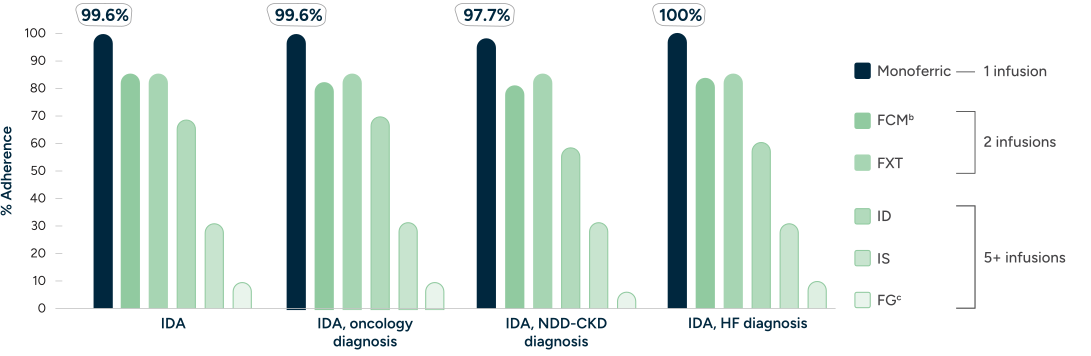
A retrospective analysis of claims data using the KOMODO’s Healthcare Map was performed to examine how adherence varies among different IV iron regimens, with a 1000-mg reference dose, for the treatment of patients with IDA. Adherence associated with IV iron products in US adults with IDA was analyzed across four separate study populations. The studies did not consider inter-product differentiation by clinical safety and efficacy.
IV iron therapy 6-week adherence in US adults, unadjusted: Results from 4 studies2‑5,a
Study limitations: Data is based on a retrospective analysis of 4 sets of claims data from the KOMODO database.
FCM=ferric carboxymaltose; FG=ferric gluconate; FXT=ferumoxytol; ID=iron dextran; HF=heart failure; IDA=iron deficiency anemia; IS=iron sucrose; IV=intravenous; NDD-CKD=nondialysis-dependent chronic kidney disease..
| a | Based on the recommended dosing in the Prescribing Information. Number of prescribed infusions can vary. |
| b | May be administered as a single-dose infusion for patients weighing 50 kg or more. |
| c | May require up to 8 weeks to receive 1000 mg of iron. |
Retrospective analyses for IV iron adherence in IDA patients across multiple disease states
A retrospective analysis of claims data using the KOMODO’s Healthcare Map was performed to examine how adherence varies among different IV iron regimens, with a 1000-mg reference dose, for the treatment of patients with IDA. Adherence associated with IV iron products in US adults with IDA was analyzed across four separate study populations. The studies did not consider inter-product differentiation by clinical safety and efficacy.
Primary objective
Quantify the rates of adherence to IV iron therapies
Adherence
- Cumulative 6-week dose ≥1000 mg of iron
Inclusion criteria
- Treatment with an IV iron product on or after January 1, 2020
- A diagnosis of IDA (ICD10-CM: D50.0, D50.8, D50.9, E61.1) in the baseline period
- Age ≥18 years on date of first IV iron infusion
- Continuous enrollment with both medical and pharmacy coverage in the baseline period, as well as 6 months following the first IV iron infusion (follow-up period)
- Oncology adherence study: primary diagnosis of cancer (ICD-10-CM: C00-D49)
- NDD-CKD adherence study: NDD-CKD diagnosis (ICD-10-CM: N18.1x-N18.5x)
- HF adherence study: HF diagnosis (ICD-10-CM: I50x)
Exclusion criteria
- Patients with end-stage renal disease or receiving hemodialysis (ICD-10-CM: N18.6x. CPT: 90935, 90937, 90940)
- Patients with a claim for IV iron during the baseline period
- Patients with a claim for hospice services
Methods
- IDA, commercial coverage2 | N=144,523 patients
(FG, n=4982; IS, n=36,751; ID, n=17,349; FXT, n=31,663; FCM, n=52,725; Monoferric, n=1053) - IDA, oncology diagnosis, commercial coverage3 | N=28,856 patients
(FG, n=856; IS, n=6546; ID, n=3419; FXT, n=7144; FCM, n=10,639; Monoferric, n=252) - IDA, NDD-CKD diagnosis, Medicare coverage4 | N=6210 patients
(FG, n=184; IS, n=1243; ID, n=508; FXT, n=1863; FCM, n=2368; Monoferric, n=44) - IDA, HF diagnosis, Medicare coverage5 | N=5127 patients
(FG, n=185; IS, n=947; ID, n=528; FXT, n=1341; FCM, n=2081; Monoferric, n=45)
FCM=ferric carboxymaltose; FG=ferric gluconate; FXT=ferumoxytol; HF=heart failure; ID=iron deficiency; IDA=iron deficiency anemia; IS=iron sucrose; NDD-CKD=non-hemodialysis-dependent chronic kidney disease.
 Previous