For US healthcare professionals


Help navigating step therapya
Many US states have enacted step therapy laws, and other states and territories may have introduced step therapy legislation.1 State-specific step therapy laws vary in scope.1
- These legislative efforts are brand-agnostic and apply broadly across therapeutic classes
- To help your patients with step therapy restrictions receive their prescribed medications, consider reviewing step therapy protections in their areab
- Patients may potentially qualify for step therapy protection if a first-step medication was contraindicated, expected to be ineffective, known or likely to cause an adverse reaction, or not in the best interest of the individual2
You may review the state-specific legislation to see which step therapy protections are available in your or your patient’s state of residence
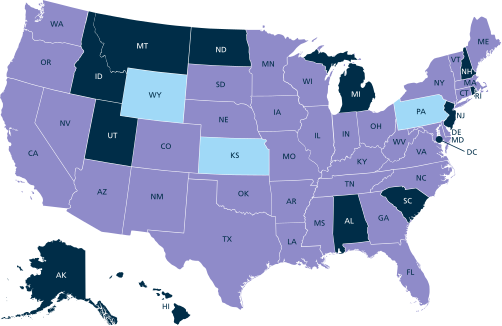
-
Legislation With Form
This state has step therapy protections, backed by enacted legislation and reinforced through a state-specific request form tailored to ensure compliance with these state regulations. -
Legislation Only
This state has step therapy protections, backed by enacted legislation that can be used as supportive reasoning when requesting a step therapy exception from a payor. Currently there is not a state-specific request form available. -
No Legislation
There are no step therapy protections enacted or pending legislation in this state.

Learn more about state-level step therapy protections and download step therapy exception request formsa,b,c
| a | Step therapy exception requirements and eligibility may vary. This information is intended for educational use only and is not a guarantee of coverage or reimbursement. Pharmacosmos Therapeutics makes no guarantees regarding the timeliness or appropriateness of this information for your particular use. The accurate completion of coverage or reimbursement-related documentation is the sole responsibility of the provider. Providers should consult with individual payors for all relevant coding, reimbursement, and coverage requirements. Contact a legal professional for information about step therapy laws in your jurisdiction. |
| b | StepTherapy.com is a third-party website unaffiliated with Pharmacosmos Therapeutics Inc. This information was developed by StepTherapy.com and is for general educational purposes only. Pharmacosmos Therapeutics assumes no responsibility for errors or omissions in the content or for any actions taken based on the information provided. Links to external third-party websites are provided for convenience and do not imply endorsement. Pharmacosmos Therapeutics is not responsible for the accuracy, reliability, or content of third-party websites. |
| c | For patients insured through national carriers, such as Aetna, Cigna, UnitedHealthcare, or Humana, consider using a step therapy exception request for the state in which treatment is rendered. For patients insured through regional associations, such as Blue Cross Blue Shield (BCBS), consider using a step therapy exception request for the home state of the network affiliate, as indicated on the patient’s insurance card. For more information, contact the state’s insurance regulator. |
If you have questions specific to Step Therapy or you would like to locate a Field Reimbursement Manager in your area, please contact us via email at STER@pharmacosmos.us
 Previous

References: 1. McBath, colleagues reintroduce bipartisan Safe Step Act to improve patient access to treatments. Lucy McBath (D-GA). April 13, 2023. Accessed August 2025. https://mcbath.house.gov/2023/4/mcbath-colleagues-reintroduce-bipartisan-safe-step-act-to-improve-patient-access-to-treatments 2. Tharp L, Rothblatt Z. Health Econ Policy Law. 2022;17(3):282-297.
