For US healthcare professionals


A randomized (2:1), open-label, noninferiority, actively controlled pivotal trial studying 1512 adult patients with IDA and intolerance or lack of response to oral iron. Monoferric was intravenously administered as a single dose of 1000 mg. Iron sucrose was dosed at 200 mg per dose up to a maximum of 5 doses according to standard practice or physician choice.1 See full study design below.
Mean change in Hb levels from baseline (ITT population) (co-primary endpoint)1,2
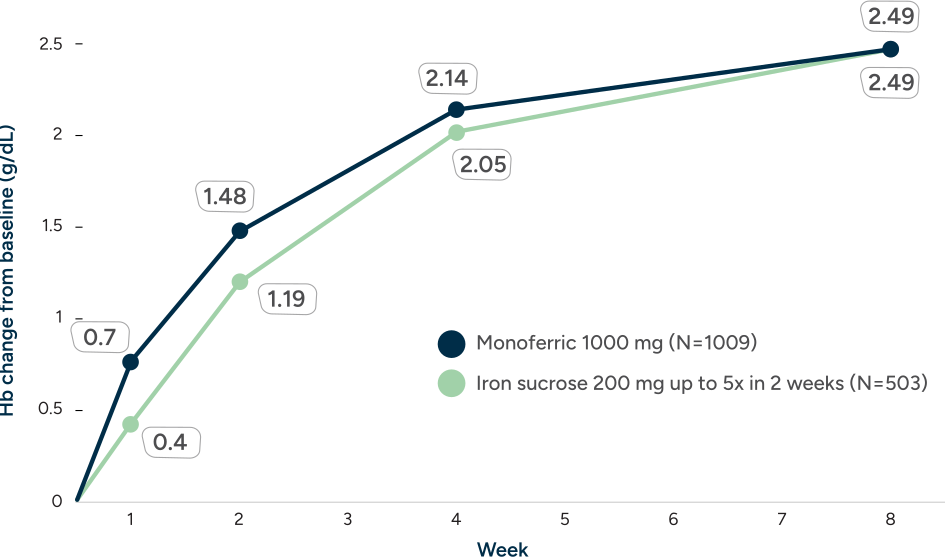
Monoferric showed a
2.49 g/dL
Hb increase from baseline to Week 8
Difference FDI-IS estimate: 0.00
(95% CI: -0.13, 0.13)
Noninferiority confirmed
Serum ferritin levels peaked ~7 days after infusion and slowly returned to stable levels at ~4 weeks.3
A randomized (2:1), open-label, noninferiority, actively controlled pivotal trial in 1538 adult patients with IDA and chronic kidney disease (eGFR <60 mL/min). Monoferric was intravenously administered as a single dose of 1000 mg. Iron sucrose was dosed at 200 mg per dose up to a maximum of 5 doses according to standard practice or physician choice.4 See full study design below.
Mean change in Hb levels from baseline (ITT population) (co-primary endpoint)2,4
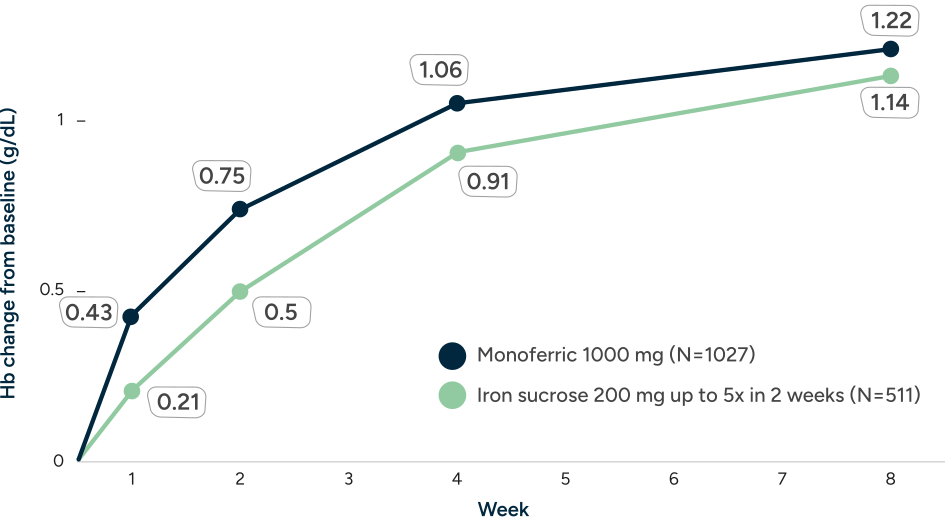
Monoferric showed a
1.22 g/dL
Hb increase from baseline to Week 8
Difference FDI-IS estimate: 0.08
(95% CI: -0.06, 0.23)
Noninferiority confirmed
Serum ferritin levels peaked ~7 days after infusion and slowly returned to stable levels at ~4 weeks.3
FERWON-IDA
Monoferric vs iron sucrose evaluated at 114 US sites1
Randomized, open-label, noninferiority actively controlled pivotal trial in 1512 patients with IDA who had documented intolerance or lack of response to oral iron.1
1512 adult patients with IDA
Selected inclusion criteria
- Age ≥18 years
- Hb ≤11 g/dL
- TSAT <20%
- s-ferritin <100 ng/mL
Selected baseline demographics
- Median age, 44 years (range, 18-91)
- 89% were women
- Mean Hb level
- 9.25 g/dL in the Monoferric arm
- 9.17 g/dL in the iron sucrose arm
1009 randomized to Monoferric
- 989 received Monoferric
- One 1000-mg dose
- IV infusion over at least 20 minutes
Randomized 2:1
503 randomized to iron sucrose
- 494 received iron sucrose
- 200 mg per dose
- Up to 5 doses
- Iron sucrose was administered as 200-mg undiluted IV injections over approximately 2 to 5 minutes and repeated according to standard practice or physician’s choice up to a maximum of 5 times within the first 2 weeks starting at baseline. A cumulative dose of 1000 mg was recommended
Co-primary endpoints1
- Incidence of adjudicated serious or severe hypersensitivity reactions from baseline to Week 8
- Change in Hb from baseline to Week 8
Selected secondary endpoints1
- Change in Hb from baseline to weeks 1, 2, and 4
- Change in ferritin and TSAT from baseline to weeks 1, 2, 4, and 8
- Hb increase ≥2 g/dL
- Change in fatigue symptoms measured by FACIT–Fatigue Scale from baseline to Week 8
FACIT=Functional Assessment of Chronic Illness Therapy; IDA=iron deficiency anemia; IV=intravenous; s-ferritin=serum ferritin; TSAT=transferrin saturation.
FERWON-NEPHRO
Monoferric vs iron sucrose evaluated at 143 US sites4
Randomized, open-label, noninferiority, actively controlled pivotal trial in 1538 patients with IDA and NDD-CKD (eGFR <60 mL/min).4
1538 adult patients with IDA and NDD-CKD
Selected inclusion criteria
- Age ≥18 years
- Hb ≤11 g/dL
- s-ferritin ≤100 ng/mL (or ≤300 ng/mL if TSAT ≤30%)
- Chronic renal impairment defined as either:
- eGFR <60 mL/min/1.73 m2
- eGFR <90 mL/min/1.73 m2 at screening and kidney damage and/or immediate/high risk of CVD
- Either no ESAs or ESAs at a stable dose (±20%) for 4 weeks before randomization
Selected baseline characteristics
- Median age, 69 years (range, 25-97)
- 63% were women
- Mean Hb level
- 9.66 g/dL in the Monoferric arm
- 9.71 g/dL in the iron sucrose arm
Randomized 2:1
511 randomized to iron sucrose
- 506 received iron sucrose
- 200 mg per dose
- Up to 5 doses
- Iron sucrose was administered as 200-mg undiluted IV injections over approximately 2 to 5 minutes and repeated according to standard practice or physician’s choice up to a maximum of 5 times within the first 2 weeks starting at baseline. A cumulative dose of 1000 mg was recommended
1027 randomized to Monoferric
- 1019 received Monoferric
- One 1000-mg dose
- IV infusion over at least 20 minutes
Co-primary endpoints4
- Incidence of adjudicated serious or severe hypersensitivity reactions from baseline to Week 8
- Change in Hb from baseline to Week 8
Selected secondary endpoints4
- Change in Hb from baseline to weeks 1, 2, and 4
- Change in ferritin and TSAT from baseline to weeks 1, 2, 4, and 8
- Hb increase ≥1 g/dL from baseline to weeks 1, 2, 4, and 8
CVD=cardiovascular disease; eGFR=estimated glomerular filtration rate; ESA=erythropoiesis-stimulating agent; IDA=iron deficiency anemia; IV=intravenous; NDD-CKD=nondialysis-dependent chronic kidney disease; s-ferritin=serum ferritin; TSAT=transferrin saturation.
Key insights from Dr Huzefa Bahrain
Hear from Dr Bahrain as he discusses why 1 dose of Monoferric is sufficient to replenish iron stores.

I’m Dr. Huzefa Bahrain, welcome to Monoferric Moments.
In my experience, we find that for most patients, just 1 dose of 1000 milligrams of Monoferric is sufficient to replenish iron stores.
Looking at all the intravenous iron infusions we’ve administered through clinical trials and commercial patients, Monoferric is observed as having a solid safety profile that is comparable to iron sucrose and is generally well tolerated by the vast majority of patients.
Monoferric has been evaluated in two clinical trials with a total of 3050 patients.
When looking at safety, there was no significant differences in adjudicated serious or severe hypersensitivity reactions between Monoferric and iron sucrose.
Only 0.3 percent of patients reported adjudicated serious or severe hypersensitivity reactions.
Monoferric was also evaluated in the PHOSPHARE study, which was two identical safety trials that were pooled to compare the incidence of hypophosphatemia with Monoferric vs ferric carboxymaltose.
Monoferric demonstrated significantly fewer incidences of hypophosphatemia than ferric carboxymaltose from baseline to day 35.
In the PHOSPHARE study, pooled results, only 8.0% of patients treated with Monoferric versus 74.4% of those treated with ferric carboxymaltose were noted to have hypophosphatemia.
For more information, explore Monoferric.com
These articles are provided by Pharmacosmos for discussion of FDA-approved uses. Monoferric (ferric derisomaltose) should be used only according to the accompanying complete prescribing information.

See Monoferric Full Prescribing Information

Have questions about the efficacy and safety of Monoferric?
Sign up to receive more information.
How Monoferric works
Monoferric has an innovative matrix structure that enables a slow and controlled release of bioavailable iron.
 Previous

CVD=cardiovascular disease; eGFR=epidermal growth factor receptor; ESA=erythropoiesis-stimulating agent; FACIT=Functional Assessment of Chronic Illness Therapy; FDI-IS=ferric derisomaltose–iron sucrose; IDA=iron deficiency anemia; ITT=intention to treat; NDD-CKD=non-hemodialysis-dependent chronic kidney disease; TSAT=transferrin saturation.
References: 1. Auerbach M, Henry D, Derman RJ, Achebe MM, Thomsen LL, Glaspy J. Am J Hematol. 2019;94(9):1007‐1014. 2. Data on file. Pharmacosmos Therapeutics Inc. 3. Monoferric (ferric derisomaltose) Prescribing Information; Pharmacosmos Therapeutics Inc., Morristown, NJ: 2022. 4. Bhandari S, Kalra PA, Berkowitz M, Belo D, Thomsen LL, Wolf M. Nephrol Dial Transplant. 2021;36(1):111-120. 5. Ilsley T, Howden EJ. J Physiother. 2023;69(4):273-274.
