For US healthcare professionals

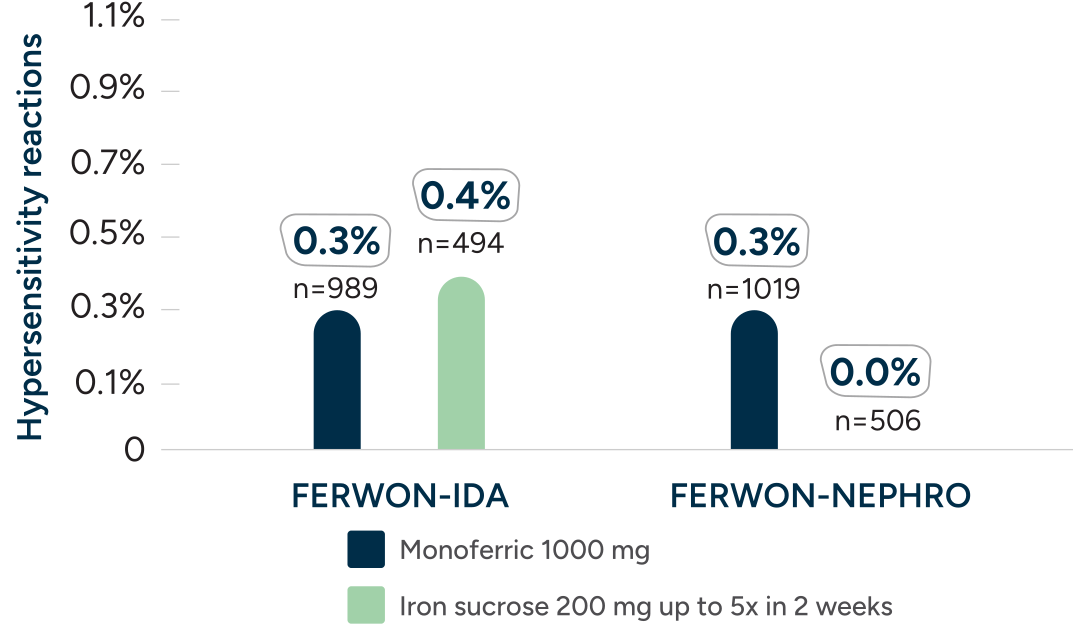
No significant differences in serious or severe hypersensitivity reactions between Monoferric and iron sucrose
Serious or severe hypersensitivity reactions associated with Monoferric were uncommon (0.3%) and were comparable to those with iron sucrose (0.2%) in the FERWON clinical trials2
Incidence of serious or severe hypersensitivity reactions between Monoferric and iron sucrose (co-primary endpoint)3,4
- Monoferric is contraindicated in patients with prior serious hypersensitivity reactions to Monoferric or any of its components1
- Serious hypersensitivity reactions, including anaphylactic-type reactions, some of which have been life-threatening and fatal, have been reported in patients receiving Monoferric. Patients may present with shock, clinically significant hypotension, loss of consciousness, and/or collapse1
FERWON-IDA
Monoferric vs iron sucrose evaluated at 114 US sites3
Randomized, open-label, noninferiority actively controlled pivotal trial in 1512 patients with IDA who had documented intolerance or lack of response to oral iron.3
1512 adult patients with IDA
Selected inclusion criteria
- Age ≥18 years
- Hb ≤11 g/dL
- TSAT <20%
- s-ferritin <100 ng/mL
Selected baseline demographics
- Median age, 44 years (range, 18-91)
- 89% were women
- Mean Hb level
- 9.25 g/dL in the Monoferric arm
- 9.17 g/dL in the iron sucrose arm
1009 randomized to Monoferric
- 989 received Monoferric
- One 1000-mg dose
- IV infusion over at least 20 minutes
Randomized 2:1
503 randomized to iron sucrose
- 494 received iron sucrose
- 200 mg per dose
- Up to 5 doses
- Iron sucrose was administered as 200-mg undiluted IV injections over approximately 2 to 5 minutes and repeated according to standard practice or physician’s choice up to a maximum of 5 times within the first 2 weeks starting at baseline. A cumulative dose of 1000 mg was recommended
Co-primary endpoints1
- Incidence of adjudicated serious or severe hypersensitivity reactions from baseline to Week 8
- Change in Hb from baseline to Week 8
Selected secondary endpoints3
- Change in Hb from baseline to weeks 1, 2, and 4
- Change in ferritin and TSAT from baseline to weeks 1, 2, 4, and 8
- Hb increase ≥2 g/dL
- Change in fatigue symptoms measured by FACIT–Fatigue Scale from baseline to Week 8
FACIT=Functional Assessment of Chronic Illness Therapy; IDA=iron deficiency anemia; IV=intravenous; s-ferritin=serum ferritin; TSAT=transferrin saturation.
FERWON-NEPHRO
Monoferric vs iron sucrose evaluated at 143 US sites4
Randomized, open-label, noninferiority, actively controlled pivotal trial in 1538 patients with IDA and NDD-CKD (eGFR <60 mL/min).4
1538 adult patients with IDA and NDD-CKD
Selected inclusion criteria
- Age ≥18 years
- Hb ≤11 g/dL
- s-ferritin ≤100 ng/mL (or ≤300 ng/mL if TSAT ≤30%)
- Chronic renal impairment defined as either:
- eGFR <60 mL/min/1.73 m2
- eGFR <90 mL/min/1.73 m2 at screening and kidney damage and/or immediate/high risk of CVD
- Either no ESAs or ESAs at a stable dose (±20%) for 4 weeks before randomization
Selected baseline characteristics
- Median age, 69 years (range, 25-97)
- 63% were women
- Mean Hb level
- 9.66 g/dL in the Monoferric arm
- 9.71 g/dL in the iron sucrose arm
Randomized 2:1
511 randomized to iron sucrose
- 506 received iron sucrose
- 200 mg per dose
- Up to 5 doses
- Iron sucrose was administered as 200-mg undiluted IV injections over approximately 2 to 5 minutes and repeated according to standard practice or physician’s choice up to a maximum of 5 times within the first 2 weeks starting at baseline. A cumulative dose of 1000 mg was recommended
1027 randomized to Monoferric
- 1019 received Monoferric
- One 1000-mg dose
- IV infusion over at least 20 minutes
Co-primary endpoints4
- Incidence of adjudicated serious or severe hypersensitivity reactions from baseline to Week 8
- Change in Hb from baseline to Week 8
Selected secondary endpoints4
- Change in Hb from baseline to weeks 1, 2, and 4
- Change in ferritin and TSAT from baseline to weeks 1, 2, 4, and 8
- Hb increase ≥1 g/dL from baseline to weeks 1, 2, 4, and 8
CVD=cardiovascular disease; eGFR=estimated glomerular filtration rate; ESA=erythropoiesis-stimulating agent; IDA=iron deficiency anemia; IV=intravenous; NDD-CKD=nondialysis-dependent chronic kidney disease; s-ferritin=serum ferritin; TSAT=transferrin saturation.
 Previous

IDA=iron deficiency anemia.
References: 1. Monoferric (ferric derisomaltose) Prescribing Information; Pharmacosmos Therapeutics Inc., Morristown, NJ: 2022. 2. Data on file. Pharmacosmos Therapeutics Inc. 3. Auerbach M, Henry D, Derman RJ, Achebe MM, Thomsen LL, Glaspy J. Am J Hematol. 2019;94(9):1007-1014. 4. Bhandari S, Kalra PA, Berkowitz M, Belo D, Thomsen LL, Wolf M. Nephrol Dial Transplant. 2021;36(1):111-120. 5. Wolf M, Rubin J, Achebe M, et al. JAMA. 2020;323(5):432-443. 6. Kaur J, Castro D. Hypophosphatemia. In: StatPearls [Internet]. Treasure Island (FL): StatPearls Publishing; 2025. Accessed March 5, 2026. https://www.ncbi.nlm.nih.gov/books/NBK493172/ 7. Zoller H, Wolf M, Blumenstein I, et al. Gut. 2023;72(4):644-653. 8. Ozer NT, Can Sezgin G, Sahin Ergul S, et al. J Gastrointestin Liver Dis. 33(3):323-329.
